Askos
| Misure | h 5,3; ø 5,7 |
| Stato | intero |
| Luogo e cronologia | Salentino - Tomb. 6. End of the 4th / early 3rd century BC |
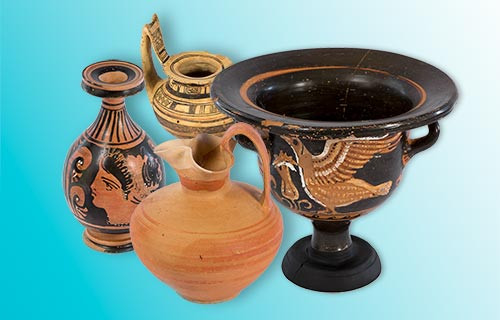
The askos is a type of vase frequently made in the indigenous productions of Daunians and Peucetians, identified by its round and flattened shape onto which a tubular neck with a spout is attached, connected to the slightly arched handle that extends along the upper part.
The shape of the neck makes it suitable for retaining the leakage of oily liquids. The popular use of this form in the Apulian area produced many variations, including those shaped like an animal or adorned with small animal or anthropomorphic figures.
Even the decoration is varied, ranging from the most ancient large achromatic vases to the red-figure decoration or the Gnathia-style vase up to the large canosan vases decorated with bands.
This type of askos is a small ring vase with a connecting handle. It was used to store and pour oil into lamps. The term is of modern use (in Greek it means " wine goatskin").